


The death of Commandant Aboubacar Diakité, widely known as “Toumba,” in the Republic of Guinea marks a significant and symbolic moment in the country’s long struggle with accountability, justice, and military involvement in politics.
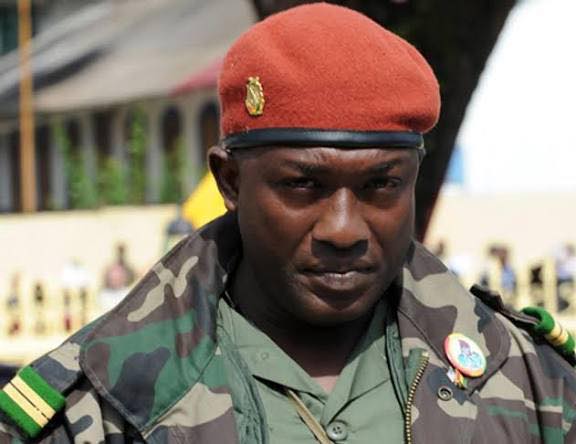
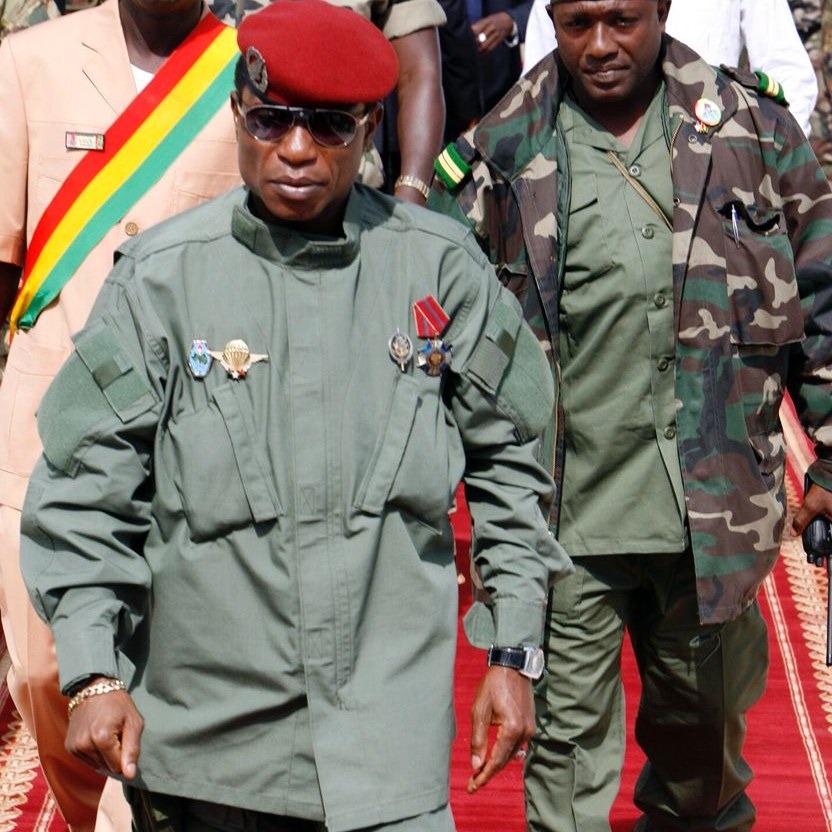
Toumba, once a powerful military figure and aide-de-camp (bodyguard) to Captain Moussa Dadis Camara, became infamous for his role in violent acts during periods of political unrest, particularly in 2009.
During his widely broadcast trial, Toumba attempted to vindicate himself, placing blame on Captain Dadis for failing to uphold promises, including plans to run as a presidential candidate. This political rift contributed to nationwide protests, culminating in the 28th of September Stadium massacre in Conakry.
Toumba’s death in detention, while serving a ten-year sentence for crimes against humanity, as confirmed in the government statement on March 25, 2026, closes a controversial chapter. It also raises deeper questions about justice and responsibility.
Lessons and Reflections
Toumba’s trajectory underscores a critical lesson: military personnel involved in violence against civilians, particularly during protests, cannot indefinitely escape accountability. Years after alleged crimes, they could render account. His case highlights a broader principle: the use of force against one’s own people especially in developing countries, carries long-term legal and moral consequences.
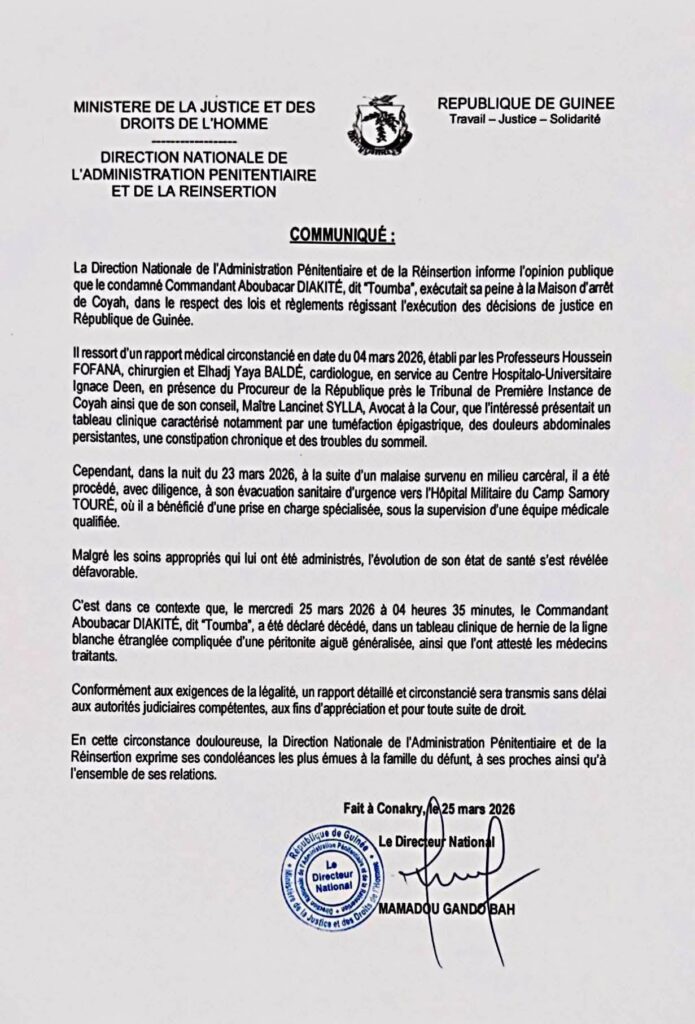
Justice must not only be done—it must also be seen to be done fairly and transparently. Toumba’s death in custody, the second among those involved in the 2009 massacre after Colonel Claude Pivi, however raises serious concerns about due process, prison conditions, and the state’s commitment to the rule of law.
Under the Current Regime
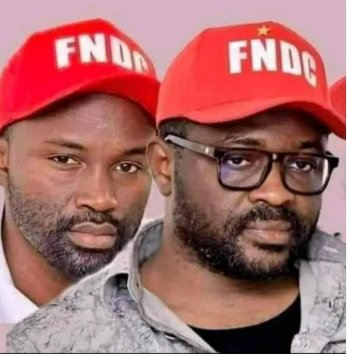
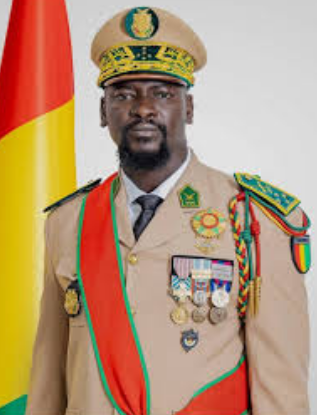
Under the current leadership of General Mamady Doumbouya, who ousted Alpha Condé in a coup after Condé illegally modified the constitution and had a third term in office in 2020, Guinea continues to face criticism for repression. Reports of crackdowns on demonstrators, restrictions on civil liberties, and the heavy-handed role of security forces indicate a troubling pattern. Renowned activists, Fonike Menge, Bill Oba, and journalist Maraoune Camara have been held incommunicado for over two years. Others like Aliou Bah were simply thrown into jail.
Toumba’s death occurs within a broader context: a country where the military remains deeply involved in governance. While past perpetrators are being prosecuted, present-day abuses may reflect similar patterns. Doumbouya’s eventual presidential candidacy, following initial promises not to run, reinforces the perception of Guinea as a nation repeatedly destabilized by military interventions, hindering its potential for economic growth.
A Call for Consistency and Reforms
For Guinea to progress, justice must be applied consistently—not only to past figures like Toumba but also to current actors implicated in abuses. Ensuring the protection of human rights, judicial independence, and civilian oversight of the military is critical.
Toumba’s death should not be seen as the conclusion of a story. It is a reminder and a warning: cycles of violence and impunity can only be broken through genuine reform, accountability, and adherence to the rule of law.
