


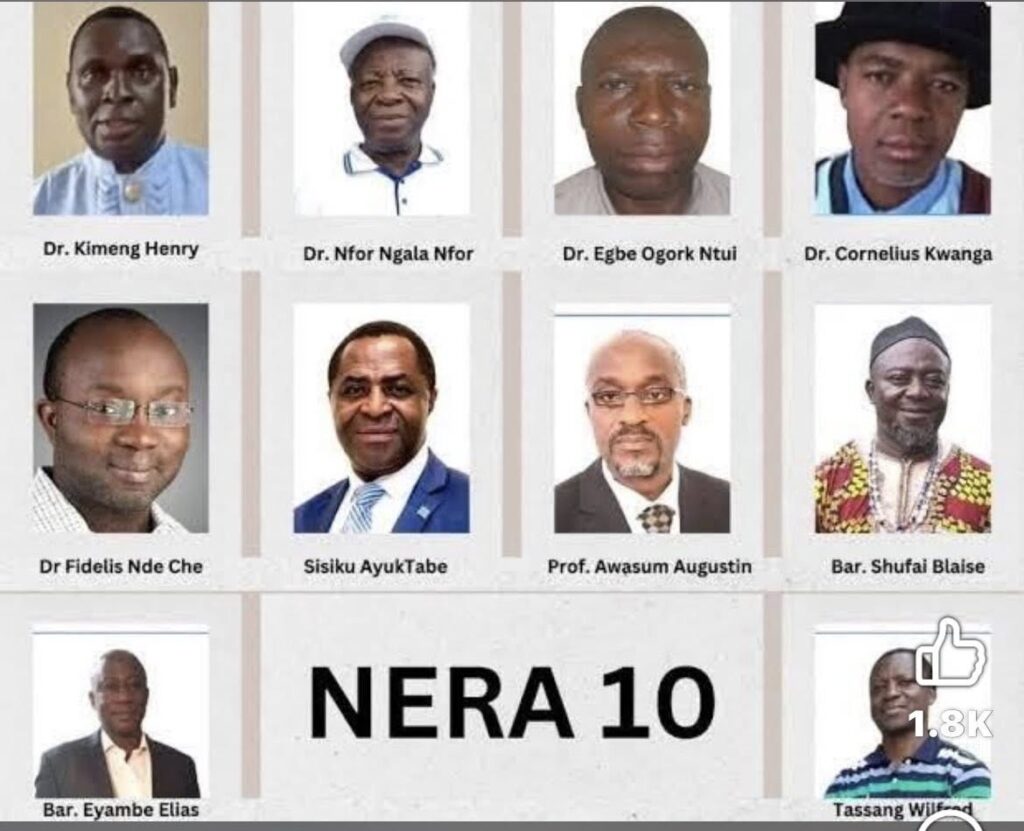
Barrister Paddy Yong, lead counsel for the Nera 10 detainees arguing that the Supreme Court ought to have freed his clients, as the Cameroonian government has been unable to prove their guilt.
In an exclusive interview, the legal mind reflects on the Supreme Court’s March 19, 2026, judgment, sending the case back to the Court of Appeal. He shares insights into the irregularities of the trial, the frustration of a prolonged nine-year detention, and the legal and humanitarian stakes facing his clients.
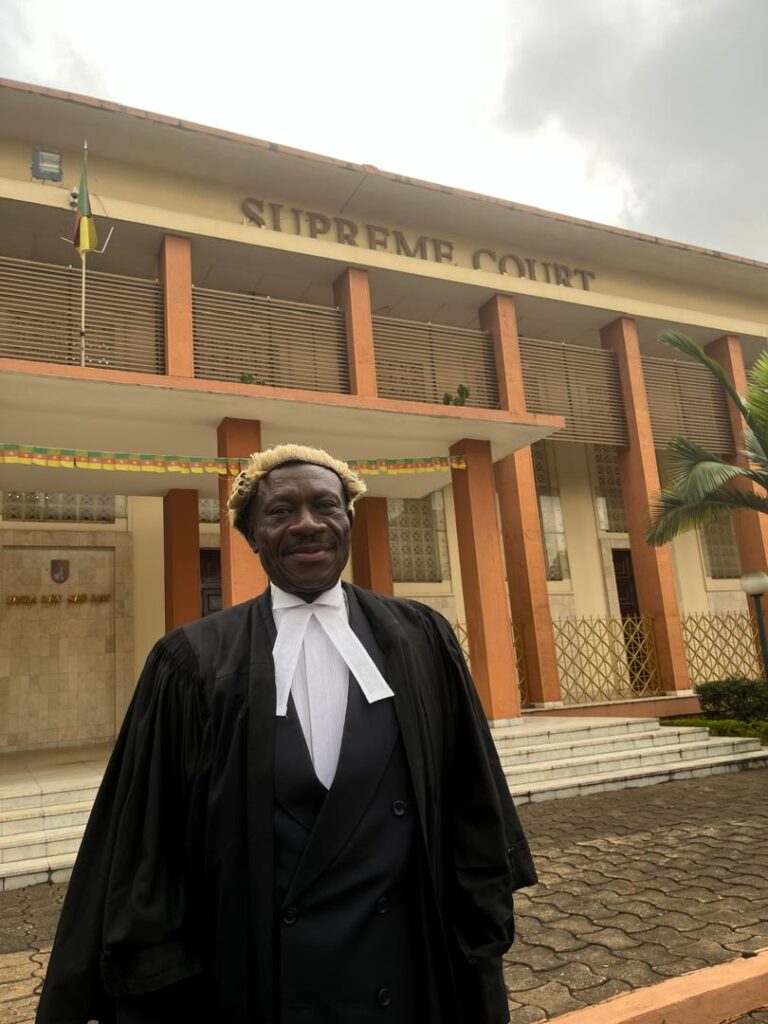
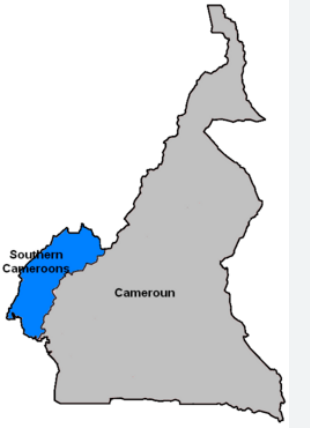
Barrister Yong also discusses the broader implications for justice, political trials, and reconciliation in Cameroon’s ongoing Southern Cameroons crisis. “It would be in everyone’s best interest for them to be released,”he stated.
Thampers Media: You were present in court when Cameroon’s Supreme Court judges delivered their judgment sending the case back to the court of appeal ordering a retrial in the Nera 10 (Southern Cameroonian nationalist leaders arrested on January 5, 2018, at the Nera Hotel in Abuja, Nigeria) case. How did you receive the judgment? Were you surprised or pleased by the decision? Do you feel that justice has been done, and that it has been seen to be done?
Barrister Yong: I have been the lead counsel for Sisiku Ayuk Tabe Julius and nine others, commonly referred to as “the Nera 10”, from when they were arrested in Nigeria and transferred to Cameroon. Even before they were charged to court, I filed the writ of habeas corpus demanding that my clients be produced. This is because after I was briefed to handle the matter, I brought in other lawyers, and we went to SED (Gendarmerie Headquarters in Yaounde) demanding to see and talk to them. But we were informed that they were not there.
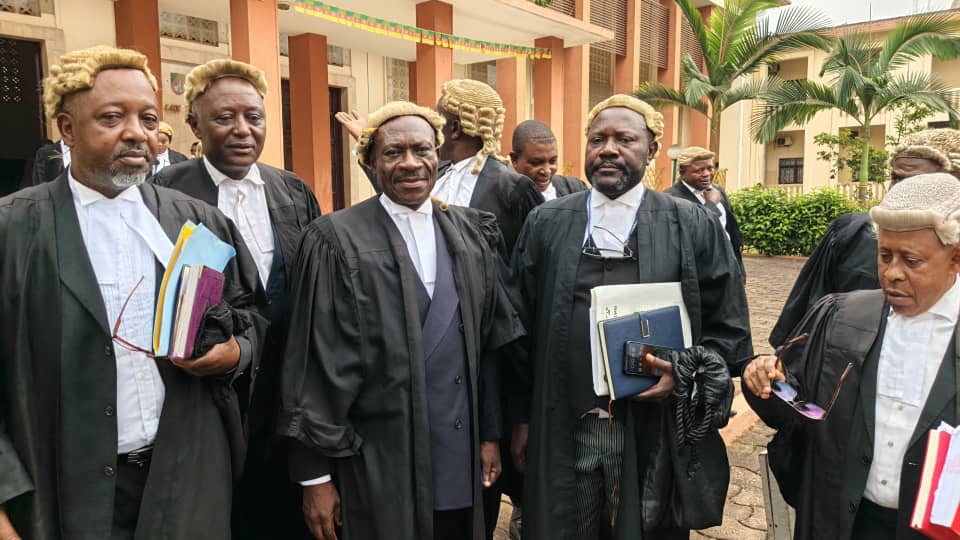
We went to the Military State Prosecutor, known in French as Commissaire du Governement, requesting that he produce them, but he said he didn’t know where they were. We reminded him that he was incharge of prosecuting them and must know where they were or be privy to that information. We equally reminded him that the then government spokesperson, the Minister of Communication, Mr. Issa Tchiroma had on national television informed Cameroonians that Sisiku Ayuk Tabe Julius and nine others had been ferried to Cameroon from Nigeria. The Military State Prosecutor rhetorically replied that we should go and ask Minister Tchiroma to present them to us!
We were then compelled to file a writ of habeas corpus in the High Court of Mfoundi against the State of Cameroon demanding that our clients be produced. This application was thrown out on the first date of hearing even though the State of Cameroon had filed no processes to either admit or deny the whereabouts of our clients. Unfortunately, due to some unforeseen circumstances I was absent in court on that day. And when informed of the ruling of that court, we immediately filed an appeal against that ruling to the Court of Appeal of the Centre region. We served the Military State Prosecutor and SED but our clients did not appear in the Court of Appeal on the first day of hearing. The judge of the Court of Appeal in adjourning the matter to a further date ordered that our clients must be produced in court. It was due to that court order that on the next date of hearing our clients were produced in court for the first time ever!
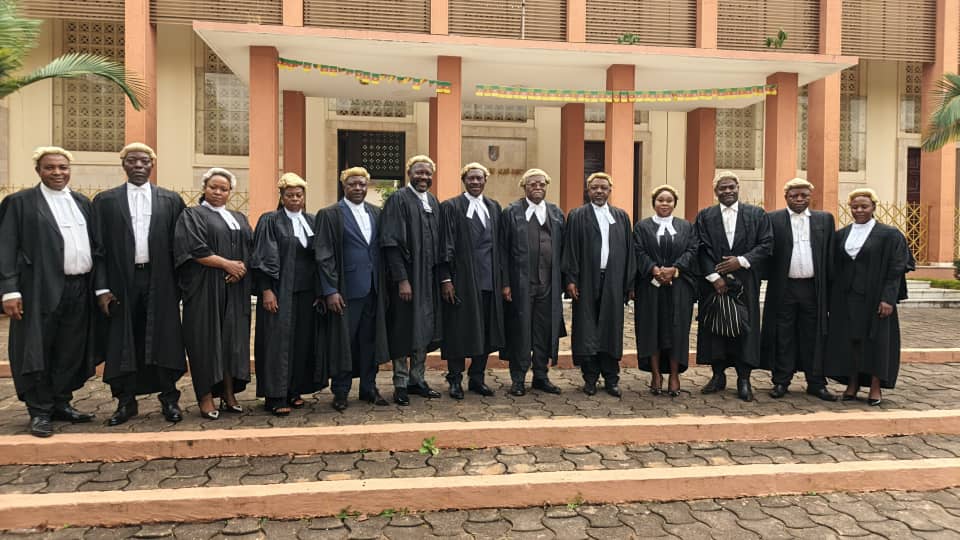
Subsequently, they were charged with the offences of terrorism, secession, hostility to fatherland etc before the Military Tribunal in Yaounde where my team and I appeared to defend them. Unfortunately, it looks like there was some sort of intimidation from the court inviting in gendarme officers. The court equally failed to listen to the lawyers of the accused persons who were submitting very vital preliminary objections contesting the jurisdiction and locus standi of that court in trying the accused persons. As a result, all the lawyers appearing for the accused persons, having realized that the court was not listening to and not taking down the issues that the lawyers raised, decided to withdraw their appearances. That notwithstanding, the Military Tribunal proceeded to try them in the absence of their lawyers and sentenced them to life imprisonment. This was a travesty of justice because the accused persons were entitled to lawyers in the face of such grievous offenses and if even if they could not afford lawyers the court had to provide or appoint lawyers to handle their defence.
We stayed on in court but no longer as their lawyers and followed the shabby proceedings till the very end. It was a marathon trial of about 20 hours. They tried them all day and all afternoon, all night and delivered a prepared judgment at about 5:30 am the next morning. After that judgement of the trial court (the military tribunal) convicting them each to life imprisonment and ordering that they should pay a fine of 5 billion francs CFA each or so to the state of Cameroon, we filed an Appeal to the Court of Appeal of the Centre region.
And what transpired at the Court of Appeal, prompting you to go to the Supreme court?
After filing our appeal to the Court of Appeal within the legal timeframe, the law requires that the processes (legal submissions) filed by the appellants, be served on the other party, in this case the State of Cameroon, represented by the Military Prosecutor or Commissaire du government.
On receiving the processes, the law gives the opposing party thirty days within which to file a reply thereto, if at all they have one. If they do file a reply, that reply will be served on the appellants who are entitled to fifteen days to file an answer. This answer is again served by the other party who equally by law have fifteen days to make a reply if they so wish. When we filed our appeal to the Court of Appeal, we never received any submissions from the State of Cameroon. The presumption is that they did not see anything to query with our submissions and thus had no reply.
When the matter came up in the Court of Appeal for hearing, we were informed by the President of the panel of three judges that they had all been transferred to different courts in the country by the recent transfers. He said further that; they were therefore going to adjourn the matter so that on the return date the new judges must have come. We said no problem and took a date when the matter was adjourned to a further date.
Surprisingly on the return date in the Court of Appeal, we saw the same judges that had been transferred still presiding. In law, once a magistrate or judge is transferred, he has no control again over the matters in that court.

When finally, the case was called up the President of that panel did not ask us anything. He instead asked the military State Prosecutor or the Commissaire du Gouvernement if he had anything to say about the case before the Court of Appeal. That is very unprocedural because the Military State Prosecutor had not filed in any submissions in opposition to our appeal. It was surprising that he was given the option to say something. We were very embarrassed. The Military State Prosecutor said he was urging the court to confirm the judgment of the trial court. And the President of that Panel did not as much as want to entertain us.
So, the court of appeal of the Centre Region just confirmed the judgment of the trial court?
Yes. We had filed in a 50-page memorandum of grounds of appeal and submissions to buttress same, challenging the judgment of the trial court. We were not given a chance to say anything. And so it is on that premise that we appealed to the Supreme Court of Cameroon. So, sending us back to the Court of Appeal again for a retrial is not something to celebrate. Not at all.
You said you submitted a 50-page memorandum challenging the judgement of the trial court. That is the military tribunal. What were some of the issues you raised in your submissions to the Appeal Court?
We filed about 10 grounds of appeal. One of the grounds was that the military tribunal had no jurisdiction to try the accused persons who are all civilians. The second ground was that our clients were illegally brought in from Nigeria to Cameroon. Our argument too was that the State of Cameroon violated international treaties and conventions because these people were all asylum seekers and/or refugees in Nigeria. The UN convention on refugees states that you cannot return people who are running away from persecution to the country where they are being persecuted. Thirdly, we argued that the whole trial at the military tribunal was against public policy and a nullity.
When we talk about nullity, we are saying that when you arrest somebody, you must inform that person of offenses you are alleging that he has committed. My clients were never arraigned at all. That process of arraignment was never respected. In law that is a nullity. If you take somebody to court and jail the person without asking him whether he is guilty or not guilty or informing him of the offences that he is alleged to have committed, the whole process is a nullity. On what basis were our clients tried?
So, you are saying that they just brought your clients to court, tried and sentenced them without hearing from them?
They were never heard. They were never arraigned. They were never informed of the offences that brought them to court. It is only after an accused person has been arraigned by informing him of the offenses on which he is being charged, and he pleads either guilty or not guilty that the prosecution will now call witnesses to give evidence to establish their case.
Are you saying that the state did not present witnesses?
No. They presented witnesses. But how can you present witnesses to prove no issue. They called a plethora of witnesses who in their testimony never linked the accused persons to any of the offenses with which they were being charged. In fact, none of the witnesses testified to knowing any of the accused persons. The accused persons having not even been arraigned or informed of the offenses which they were being charged with, the evidence of the witnesses went to support no issue.
Who were these witnesses?
One of the witnesses called by the military state prosecutor was a Colonel (military doctor). The other witnesses were all military personnel.
So far have the courts been able to prove the accusations against your clients?
No. I am saying that the whole trial was a nullity. We submitted strongly that this country has a history of violating their own laws. We raised this issue of civilians who are not supposed to be tried in the military tribunal. There is an international jurisprudence on that. The Cameroon Constitution states that where there is conflict between national and international law, treaties and conventions the latter shall prevail over the former. If the court should proceed to try civilians in a military tribunal despite the provisions of the constitution, then there is a problem. The courts have not been able to proof the accusations.
Barrister Yong, you argued a while ago that there were sufficient grounds for the Appeal Court’s decision to be quashed, yet the Supreme Court has instead sent the matter back to the Appeal Court. How do you interpret this outcome?
I must state that we raised the issue of arraignment and jurisdiction. But the Appeal Court instead gave a listening ear to the Military State prosecutor and not the submissions from the appellants.

Again, when the Supreme Court in its judgment said that the appeal succeeds, it means that all the issues we raised before the Supreme Court, were grounded in law and found favour with the court. It is on that premise that the Supreme Court had to question the judgement of the Court of Appeal. Now what was our prayer at the Supreme Court? Our prayer was that the Court of Appeal’s judgement should be quashed and that our clients be discharged and acquitted. Remember that one of the grounds that we raised was that the whole trial was a nullity. That the law itself provides for that. Section 3 of Cameroon Criminal Procedure code is very clear on that. That section provides:
“3 (1) The sanction against infringement of any rule of criminal procedure shall be an absolute nullity when it is:
a) Prejudicial to the rights of the defence as defined by legal provisions,
b) Contrary to public policy.
(2) Nullity as referred to in subsection (1) of this section shall not be overlooked. It may be raised at any stage of the criminal proceedings by any of the parties and shall be raised by the trial court of its own motion.”
When grave issues like non-arrangement happen as is in this case, the trial should be declared a nullity. The Supreme Court gave a judgment quashing the judgment of the Appeal Court and stating that the appeal succeeds. That they were sending us back to the Appeal Court for a retrial. The Supreme Court also opined that the Appeal Court proceedings were replete with a lot of irregularities. But when the Supreme Court said it was ruling suo moto it meant that they were not relying on the grounds that we filed with the Supreme Court. It was on their own observation. That is not clear. If they looked at our grounds of our appeal and were not satisfied but saw their own grounds on which to allow that appeal to sail through, they can suo moto raise those issues of law and on that ground allow our appeal. They did not say that they looked at the grounds of appeal and did not find substance but just said their decision was suo moto.
We expected them to examine the grounds of our appeal. The Supreme Court is the final court. Having found that the proceedings were replete with a lot of irregularities we expected them to say the appeal succeeds because these issues of law have been violated and our clients were discharged and acquitted.
You indicated that the court ruled suo motu in addressing the Appeal Court’s judgment. How do you interpret this approach? Can we insinuate the decision was politically motivated?
I cannot say whether they examined our grounds of appeal or not but there is a provision of the law which provides for suo moto rulings. See section 3 of the Criminal Procedure Code as afore cited. As a lawyer, I cannot say whether their suo moto ruling is politically motivated.
Let us now turn to the possible scenarios at the Appeal Court, where the case has been referred. What do you expect to happen there? Do you foresee a different outcome this time, possibly one that could lead to your clients’ release, given that this is the same court whose decision you previously challenged at the Supreme Court?
We are going back to the Court of Appeal as if we were coming from the trial court. We are going back to the position where we were before the judgement of the Court of Appeal.
If we are going back as if we were coming from the trial court, it means that our submissions supporting our appeal before the Court of Appeal is valid and tenable before that court. This is because the law says that when the judgment is passed and in this case the judgement of the military tribunal, we have ten days to give notice. And after that, 15 days to file our memorandum of grounds of appeal and submissions to buttress same to the Court of Appeal. We had done so within the time prescribed by law, within statutory time.
When those submissions are served to the opposing party which is the Military State prosecutor, he had 30 days to reply to that our submission. Those days passed. If they did file in any submission, the registry of that court would have served us with their reply, and we would have filed further submissions until the matter was ripe for hearing. They never filed anything and now they are time barred. They cannot file in anything now. The scenario here is that only our appeal is before the Court of Appeal. So, at the Court of Appeal, we are merely going to adopt the submissions which we filed in, to buttress our appeal. And then the court will give us room to expatiate.
Is there the possibility that the Court of Appeal examines the grounds of your appeal this time around and releases your clients?
We have submitted before and will submit again and again that our memorandum of grounds of appeal and submissions to buttress same was never challenged by the opposing party. What is the legal implication? It will imply that the opposing party found nothing with which to challenge our appeal and thus the court has to do the obvious by discharging and acquitting our clients.
We also note that no date has been set for the retrial at the Court of Appeal. Is there a risk that this could lead to delays?
The registry of the Supreme Court will have to type the proceedings before the Supreme Court and transmit those proceedings back to the Appeal Court. The Registry of the Court of Appeal will then give us a summons stating a date to appear before that court.
Is there hope that it would not take too long?
That is our hope as well. The curious thing is that the law does not really define the time during which they are supposed to do that. We just hope that it does not take too long. If they can do that within a maximum of one month that would be fine for us. But we don’t control the registries of both courts. We rely on good faith and their conscience that they should do everything possible to tidy up those records.
By returning to the Court of Appeal, is there a possibility that the case could go back to the Supreme Court and continue back and forth? Is that likely?
Definitely. We may go back to the Supreme Court. Not only us. Even the State of Cameroon may go there. My position is that having held that our appeal succeeded, having held that the judgement of the Court of Appeal is quashed, my clients have been in detention for 9 years.
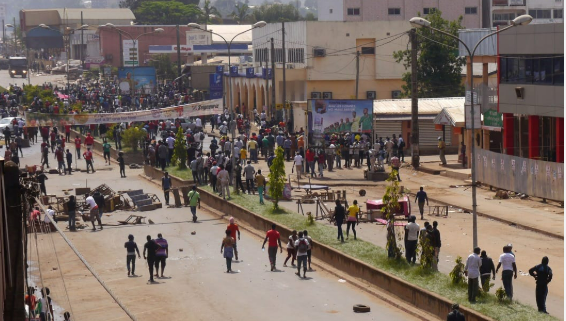
I am so frustrated because the Supreme Court, having held that the proceedings were replete with a lot of irregularities, it was just good enough for the Supreme Court to discharge and acquit our clients. Simple!
This trial is widely viewed as highly political, despite being presented as a legal process addressing alleged offenses. How do you respond to this perception?
Well, since you cannot really put a thin line against that, you may not be wrong to say it is a political trial. My clients were charged with secession and hostility against the nation etc. When they charge them for secession it becomes political.
Was the option of bail explored by your clients, considering they are prominent figures who are prepared to appear in court and are may not be considered a flight risk?
Some of those offences are not bailable offences. But then the trial court can always use their discretion and grant them bail. We tried in the military tribunal and bail was rejected.
Will this case not ultimately fall under the jurisdiction of an international court?
If we go to the Court of Appeal and win our case and our clients are discharged and acquitted, we will not have any reason to appeal to the Supreme Court. If we win and they appeal to the Supreme Court and the judgement discharging and acquitting our clients is upheld, we will not need to go to the international tribunal. This is because before accessing the international tribunal, you must show proof that you have exhausted all local remedy. If we go to the Supreme Court and we are not satisfied, we can now go to the international tribunal.
I understand you cannot speak about your clients’ thoughts, but how do you think they are feeling about everything that is happening?
No person will want to stay in prison for 9 years. A person that is claiming that he is innocent. A person that nothing has been so far presented to prove his guilt. That person cannot be happy. Our clients are not happy.
Are you standing just for the Nera 10 detainees or for the thousands of other Southern Cameroonian detainees scattered in different detention facilities?
I don’t appear for them generally, but I have defended a couple of them. Some of them got discharged and acquitted in the military tribunal, some in the Court of Appeal. Some were convicted and given minimal sentences.
There has been considerable discussion about de-escalating the Southern Cameroons crisis, particularly regarding the release of the Nera 10 detainees and other individuals considered political prisoners. What is your perspective on this?
As lawyers for Nera 10 we are looking forward to that day when the trial will come to an end, and our clients walk out free. We have always said that they were not guilty of any offences and till now that is our firm conviction. I would want my clients to walk out of prison.
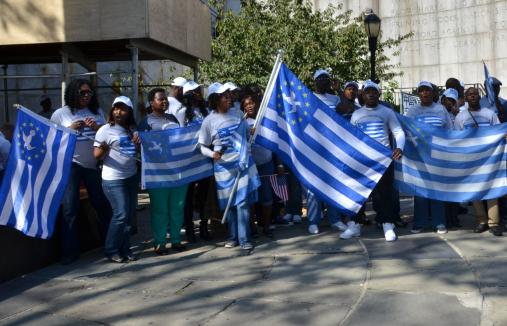
I think and I am praying that if this matter goes to the Court of Appeal the court should exercise the law judiciously and objectively. And of course, I am confident that our appeal before the Court of Appeal under normal circumstances should succeed. That is my fervent wish. These are people that have families. These are people that have children. These are people that have wives. These are people who like in any other African family have other people depending on them for their livelihood. For 9 years you can imagine how much pain they would have caused not only them but their families and extended families. And besides at the end of the day, it is not only punishment that is paramount. At the end of the day, we are talking about reconciliation. Let us look at the grievances of the people and see how we can reconcile those grievances above all. It would be of the better interest of everybody for them to be released.
Interviewed by Solomon Amabo
Photos: File
Photo: File